Why is Microsoft taking down the Authenticator password filling feature?
Microsoft is removing Autofill from Authenticator by July 2025 and pushing users to Edge. Here's why the feature is being retired and what to use instead.

- Louis
- 4 min read
- Affiliate Disclosure

Recently, Authenticator users should have seen a reminder in the app when opening the app - Autofill in Microsoft Authenticator will stop from July 2025, and users are advised to use Edge instead. The plan is as follows:
- Starting June 2025, you will no longer be able to Add or Import new passwords in the Authenticator App. However, you can continue saving passwords through autofill until July.
- During July 2025, you will not be able to use autofill with Authenticator.
- From August 2025, your saved passwords will no longer be accessible in Authenticator.
It can be seen that from stopping adding new passwords to disabling auto-fill, to being completely inaccessible, Authenticator is gradually stripping away its password-related functions, but many users use Authenticator precisely because it can synchronize and fill passwords across platforms. So why does Microsoft do this?
We speculate that the first reason is that the functions of Authenticator and Edge overlap.
Windows 11 comes pre-installed with Edge browser, which is used to replace the outdated IE. As a modern browser, Edge has a built-in full-featured password management function that can save users’ passwords on various websites and automatically fill them in. Because it is the default browser for many Windows users, it collects and saves a large number of user passwords.
Authenticator is also a Microsoft product, but most of its passwords are not manually added by users, but are synchronized from the passwords saved in Edge. On iOS and Android devices, the Edge browser can also fill in passwords. In this regard, the functions of Edge and Authenticator overlap.
Combining the same functions in one application can integrate Microsoft’s internal resources, optimize manpower and save costs.
The second reason is that Edge has a low market share on mobile devices, and Microsoft is eager to promote the Edge browser.
As mentioned before, Windows 11 comes pre-installed with Edge browser. Since Edge uses the Chromium kernel, its performance, compatibility and functions can meet the needs of most users. Therefore, although its market share is far less than that of Chrome browser, it has also “bitten a piece of meat” from Chrome’s desktop market share. The situation on the mobile side is completely different. Microsoft lacks ecological control and cannot seize the market by pre-installing, so Edge’s market share is much lower than other browsers.
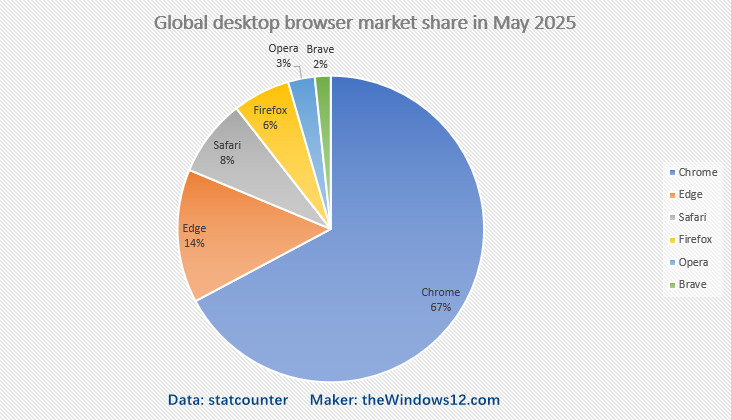
This is the global desktop browser market share in May 2025. Edge ranks second with a market share of 14%, which is consistent with our intuition:
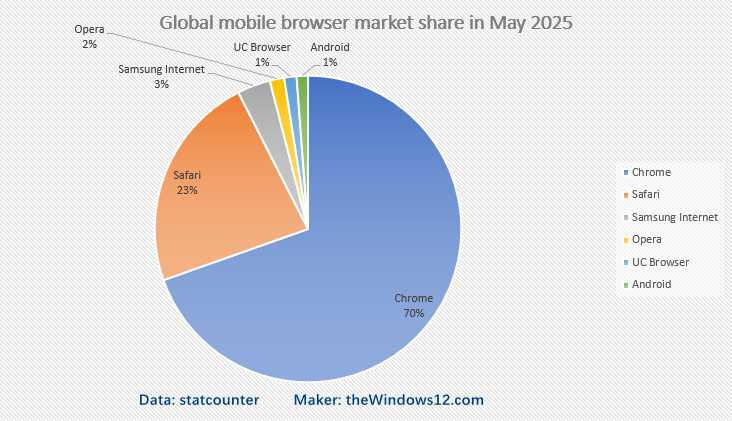
However, on mobile devices, Edge is not even among the top browsers. The market share of Safari and Samsung Internet also proves the importance of controlling the operating system ecosystem.
Windows is still the most important desktop operating system, and its users also use mobile phones, so there is a need to synchronize passwords across platforms. Microsoft removed the password function of Authenticator and “drives” users to install and use the Edge browser on their phones, which indirectly revealed Microsoft’s anxiety about the failure of the mobile market.
As both are in-house applications, why is Edge more important than Authenticator?
Since its birth, browsers, as the most important entrance to the Internet, have always been the focus of competition among major Internet companies. Whoever controls the browser controls the initiative. For example, when Chrome became popular, the first consideration for front-end developers was compatibility with Chrome.
Why does Google have to win the browser competition? Because it directly affects Google’s usage rate, and thus its advertising revenue. In 2022, Google paid Apple about $20 billion just for Apple to set Google as the default search engine in its browser. If Chrome instead of Safari accounted for the majority of iOS usage, then the $20 billion would directly become Google’s revenue instead of cost.
Compared with the Edge browser, which serves as the gateway to the Internet and can collect various important data, Authenticator only provides password management and identity authentication functions. It cannot create more market value for Microsoft, so it is inevitable that its functions will be weakened.
