Windows 10 Users Have Just Two Months Left Before NVIDIA Moves On
NVIDIA will ship its final Windows 10 GeForce driver in October 2026. After that, Windows 10 users get no new Game Ready or Studio Driver updates.

- Louis
- 5 min read
- Affiliate Disclosure

Still using Windows 10 on a GeForce-powered PC? You may want to keep an eye on the calendar.
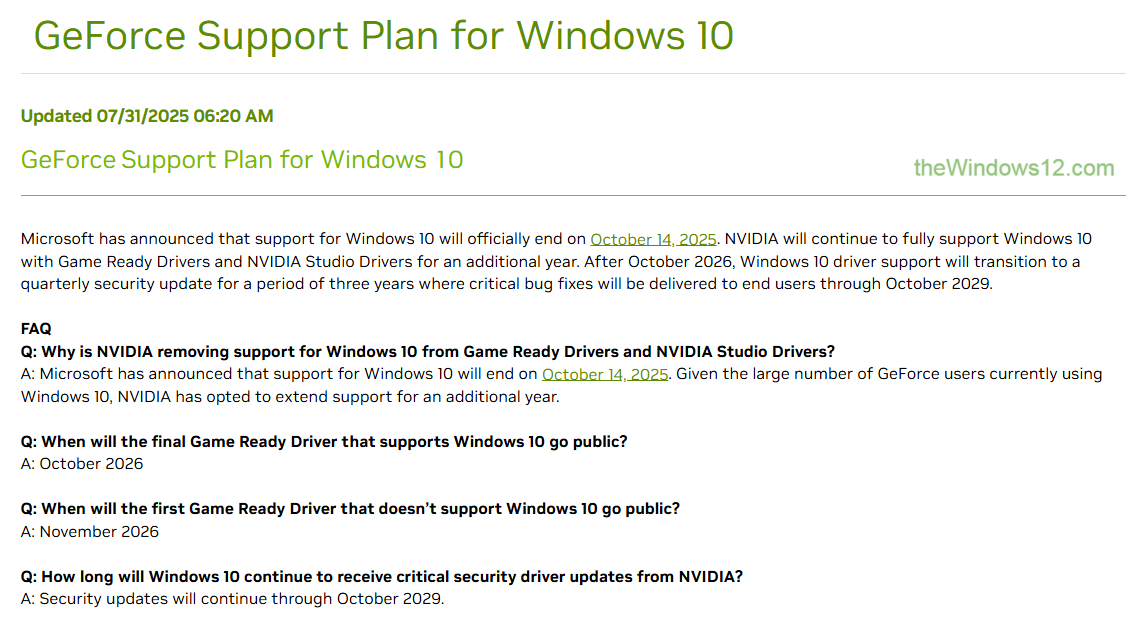
NVIDIA is now just a couple of months away from ending regular driver support for Windows 10. In October 2026, the company will release the final GeForce Game Ready Driver and Studio Driver that support Microsoft’s aging operating system. Starting in November, new driver releases will move forward without Windows 10.
This didn’t come out of nowhere.
NVIDIA announced the plan back in July 2025, when the deadline still felt comfortably far away. Fast forward to August 2026, and we’re now approaching the point where that policy becomes reality.
For Windows 10 users who have been putting off an upgrade, this is one of the clearest signs yet that the broader PC industry has already shifted its attention elsewhere.
What Exactly Is Changing?
Under NVIDIA’s support plan:
- Microsoft ended mainstream Windows 10 support in October 2025.
- NVIDIA extended full GeForce driver support for an additional year.
- October 2026 will bring the final Windows 10-compatible Game Ready Driver and Studio Driver release.
- Beginning in November 2026, new GeForce drivers will no longer support Windows 10.
- Windows 10 will move into a security maintenance phase rather than losing support entirely.
- Quarterly security driver updates will continue through October 2029.
The important thing to understand is that your graphics card isn’t about to stop working.
If you wake up in November still running Windows 10, your RTX GPU won’t suddenly become unusable. Existing drivers will continue to function just as they do today.
What you’ll be missing are the future updates.
Keep in mind this only covers the GPU driver. For the operating system itself, Windows 10 already left mainstream support in October 2025, and staying patched beyond that requires Microsoft’s Extended Security Updates (ESU) program.
Why This Matters More Than It Sounds
At first glance, losing driver updates may not seem like a huge deal. If your current setup works fine, it’s tempting to assume nothing really changes.
Over time, though, driver support matters more than many people realize.
New Games Will Be Optimized for Newer Platforms
One of the main reasons NVIDIA releases Game Ready Drivers so frequently is to support major game launches.
These updates often include performance improvements, bug fixes, stability enhancements, and game-specific optimizations that arrive right alongside new releases.
Once Windows 10 falls off the support list, future Game Ready improvements will naturally focus on Windows 11 and newer platforms.
That doesn’t mean new games will instantly stop running on Windows 10. However, it does mean Windows 10 users may gradually find themselves missing out on:
- Performance improvements
- Launch-day fixes
- Graphics feature enhancements
- Driver-level game optimizations
The difference may be small at first, but it tends to grow over time.
Creators Could Feel the Change Even More
The same story applies to NVIDIA Studio Drivers.
If you use applications like Premiere Pro, DaVinci Resolve, Blender, Unreal Engine, or local AI tools, Studio Driver updates often deliver meaningful improvements behind the scenes.
That can include:
- Better software compatibility
- CUDA and GPU compute optimizations
- Stability improvements
- Support for newer AI features and workflows
As development shifts fully toward supported operating systems, Windows 10 users will gradually stop receiving those benefits.
For creators, that could become more noticeable than the gaming impact.
The Industry Has Already Chosen Windows 11
Looking beyond NVIDIA, it’s hard to ignore the broader trend.
Whether it’s AI PCs, Copilot+ PCs, next-generation GPUs, or future Windows features, almost every major push in the PC industry is happening on Windows 11.
Hardware vendors are optimizing for it. Software developers are prioritizing it. New PC launches are built around it.
NVIDIA’s Windows 10 driver deadline isn’t an isolated event. It’s part of a larger transition that’s been happening for several years.
NVIDIA Actually Gave Windows 10 Users Plenty of Time
To be fair, NVIDIA has handled this transition more gently than many companies would have.
The timeline looks like this:
- Windows 10 reaches end of support at Microsoft: October 2025
- Full NVIDIA driver support ends: October 2026
- NVIDIA security updates continue through: October 2029
That’s a surprisingly long runway.
Rather than cutting support as soon as Microsoft moved on, NVIDIA gave GeForce users an extra year of full driver updates and committed to three additional years of security maintenance.
This feels less like a sudden cutoff and more like the final stage of a long retirement process.
Should You Upgrade to Windows 11?
For some users, there may be no rush.
If your PC is mainly used for web browsing, office work, media playback, or older games, Windows 10 will continue working long after October 2026.
But the calculation changes if you’re someone who:
- Plays newly released games
- Creates content professionally or as a hobby
- Uses local AI applications
- Plans to buy a future GeForce GPU
- Likes staying up to date with the latest NVIDIA features
For those users, Windows 11 is increasingly becoming the platform where new development is happening.
And with only two months remaining before the final supported GeForce driver arrives, the transition is no longer some distant future event.
It’s almost here.
Final Thoughts
The story isn’t really that NVIDIA announced the end of Windows 10 driver support.
That announcement happened more than a year ago.
What’s notable now is that the deadline is finally within sight.
In just a couple of months, Windows 10 will receive its last fully supported GeForce driver release. Security updates will continue for several more years, but new Game Ready features, Studio Driver enhancements, and future optimizations will move on without it.
For now, there’s no need to panic. Existing systems will continue working, and NVIDIA isn’t pulling the plug overnight.
But the direction of travel is pretty clear.
Microsoft has already moved on. PC manufacturers have moved on. And now NVIDIA is wrapping up its transition as well.
If you’re planning to keep your PC for the next few years, you’ll probably end up on Windows 11 sooner or later. The only real question is whether you make the move before the final Windows 10 driver arrives, or after.
